November 20, 2025
AREF Grantees are Leading Change
By Alberta Real Estate Foundation
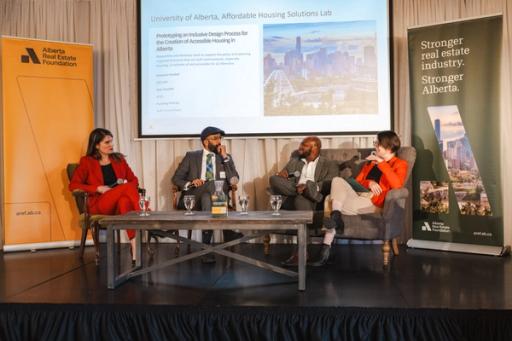
Our October Leading Change event highlighted similar challenges and collaborative solutions to housing equity and sustainability
Last month, more than 40 real estate professionals, nonprofit partners, researchers and policy makers gathered to hear from grantees about how their innovative solutions to Alberta’s housing challenges — and how the real estate industry can continue to respond.
The event, held at The Bell on Scona in Edmonton, was the second in a series that invited cross-sector dialogue on a wide range of topics affecting the Alberta real estate industry, including downtown revitalization, affordability and equity in real estate, and climate resilience. Our recent engagement with industry members, grantees, and sector partners told us that the Alberta Real Estate Foundation (AREF) is uniquely positioned to lead, connect, and support. Events like this one are the response to your call for more opportunities to share knowledge, build relationships, and spark collaboration across the real estate ecosystem.
Real estate touches every facet of our lives, from where we live, work, and spend our recreational time to how our cities, provinces, and countries are shaped. It affects the quality of our day-to-day life, shaping how we grow up, form our own households, and age.
AREF’s unique funding model has invested more than $32 million into over 800 projects that improve how we live, work, build, and grow together in Alberta. What emerged from these moderated and informal discussions was one recurring theme: the problems we face can seem daunting, but there are industry and community partners working together in innovative ways to overcome those challenges and make life better for all Albertans.
Representation matters, in so many different ways
Representing diverse groups is vital to ensuring housing equity, but also to creating a real estate sector that can respond to our changing world. It’s something the real estate industry has long struggled with, but the tides are starting to turn.
BOMA Edmonton and North’s (former) President and CEO, Lisa Baroldi, helped start a workforce initiative to help Indigenous workers at any stage of their careers involved in commercial real estate. Baroldi felt that Alberta’s real estate industry has been slower to take steps toward reconciliation, and as a result, Indigenous Albertans don’t often consider it an industry available to them.
“The real estate industry is built on Indigenous land, but it has not grown with Indigenous people,” Baroldi says. Inclusivity is preparation for the future — and an act of reconciliation. The real estate industry often sees inclusivity as a “warm and fuzzy” thing, but it makes good business sense. Baroldi suggests there may come a time when every project will require Indigenous consultation, and an inclusive industry that has made steps toward reconciliation is far better positioned to adapt.
For Andrel Wisdom at the REET Institute, inclusion means first-generation Canadians have an ‘on-ramp’ to the real estate industry through initiatives that help them build networks, get work experience, and see themselves represented in the industry. The REET Institute is a social impact platform designed to educate and train underserved youth about commercial real estate, and their initiatives have resulted in youth starting careers — and winning accolades — in a sector they might never have considered otherwise.
“Familiarity is a key driver for where opportunities are given. It’s done with the right intention — you work with who you know — but you just recycle the same old opinions and backgrounds, and it’s a hindrance to getting the best possible talent,” says Andrel.
There’s no one single solution for solving the housing crisis
Solving the housing crisis is not as simple as building one kind of home — or even simply building homes themselves. Communities have needs as unique as the people who live in them. Rural areas, for example, face vastly different challenges than urban centers. Melissa Fougere, President and CEO of the Rural Development Network, pointed out that in urban centers, building is often hampered by permitting. In rural communities, smaller municipalities have expedited that — their challenges lie in finding trades to build homes, or access to materials.
Inclusion results in homes that serve more people, better. Any housing solution has to recognize that cultural differences, differences in ability, and our communities shape how we use our spaces. Multigenerational households are the norm in some parts of the world; some cultures value communal living space over bedroom size; people with disabilities do not all need the same accommodations, or may use their space in ways often overlooked by designers without that experience; people living rurally may not use their homes the same way urban dwellers do.
In terms of accessibility, Joshua Evans, associate professor of Human Geography at the University of Alberta, is working with the Affordable Housing Solutions Lab to find ways to include people with disabilities in the consultation process. Any solution to the housing shortage must accommodate people with diverse needs and account for a range of disabilities, and the key to achieving that is involving them at the earliest stages of development — during consultation sessions, before design has started.
“Power is the key word here,” says Evans of the housing design process, especially when it involves accessibility. “It’s a challenge for the industry, but also for people in the community.”
Accessibility and representation in the consultation system itself is also vital — a session that asks attendees to write their ideas on paper is not useful to someone who cannot see, for example. A crowded room is not welcoming to someone with sensory challenges. Hearing from people with diverse backgrounds provides an essential picture of what people need beyond the mainstream.
People are working together across sectors to solve big problems
Every one of AREF’s partners draws on expertise from other sectors to make their initiatives work.
Omar Yaqub, executive director at IslamicFamily, works to build bridges between private property owners and settlement agencies to reduce evictions and increase housing access for newcomers and racialized tenants. His work involves creating connections between financial institutions, property owners, and social service agencies.
“Often people come to us in the midst of an eviction. We’re willing to write a check to cover the rent, but the landlord doesn’t know who the organization is, they aren’t sure about the money — it causes anxiety for every party,” Omar says. “We work with AREF to bridge the trust gap between the housing provider and the social services provider so everyone has the housing and services they need.”
IslamicFamily’s work highlights the delicate interplay between organizations, and how vital relationship-building is to developing trust on all sides. The social services landscape can be complex, and figuring out which agency is best poised to help can be challenging for service providers, police officers, and others.
“Housing is about more than what’s functional, it includes the availability of supports and services, affordability — all those things that are interconnected that can enable or restrict people’s housing choices,” says Evans.
It takes innovation to meet future demands
Solving these complex problems often requires turning the problem on its head. And this is often where inclusion has real benefits.
Vlad Ruban, an advisor on the innovative Housing Complex project, highlights the need for housing equity through photos and interviews, capturing the stories of 12 Edmontonians, including Omar Yabuq, who play roles in the housing system. The AREF-funded project illustrates how diverse the needs are, even within one city.
“Those stories illustrate everyone in the room,” says Vlad. “Everyone has a crisis once in a lifetime, or even more.”
Trust is key — at every stage
Whether it’s building relationships between social services and landlords or ensuring the consultation process is inclusive and ethical, the industry must continue to build trust with all stakeholders.
Ruban points to the need for a strong safety net for people who are “on the verge.” If we can catch them at the right time and the right place, we can create communities that are safer,” he says. “Important initiatives create an atmosphere of trust, and trust forms the base for everything else.”
Property owners, realtors, and other industry professionals have a role to play in building that trust, as they help shape the housing environment, but Ruban notes they could also benefit from additional support from local governments.
On the design side, making a “strong ethical commitment to inclusion” in the engagement process helps build trust between participants and developers, says Evans. Fougere agrees. “We do the pre-development work, so we ask, ‘Who's not here? Who needs a voice? Who should be here?’ Everyone is different and they approach things differently.”
Hope for the future
The panel discussions and informal conversations revealed that while our challenges are significant, there’s no shortage of Albertans with novel solutions. Even as it’s sobering to discover the scale of these challenges, it’s inspiring to see what our grantees are achieving.
AREF supports some of the province’s most impactful projects, which contribute to our land, built environments, consumers and industry. Our work gives real estate professionals and homebuyers another reason to feel great about their transaction. Events like Leading Change are an opportunity to tell our good news stories, and to share learning and insights with partners, policymakers, and researchers — and those connections can spark inspiration, build new relationships, and lead to a better future for everyone.
Want to see the energy at Leading Change?
View the Calgary and Edmonton event photo galleries.
Topic
Contributor

Alberta Real Estate Foundation
The Alberta Real Estate Foundation invests in real estate* policy, research, practices, and education that strengthen Alberta’s communities.